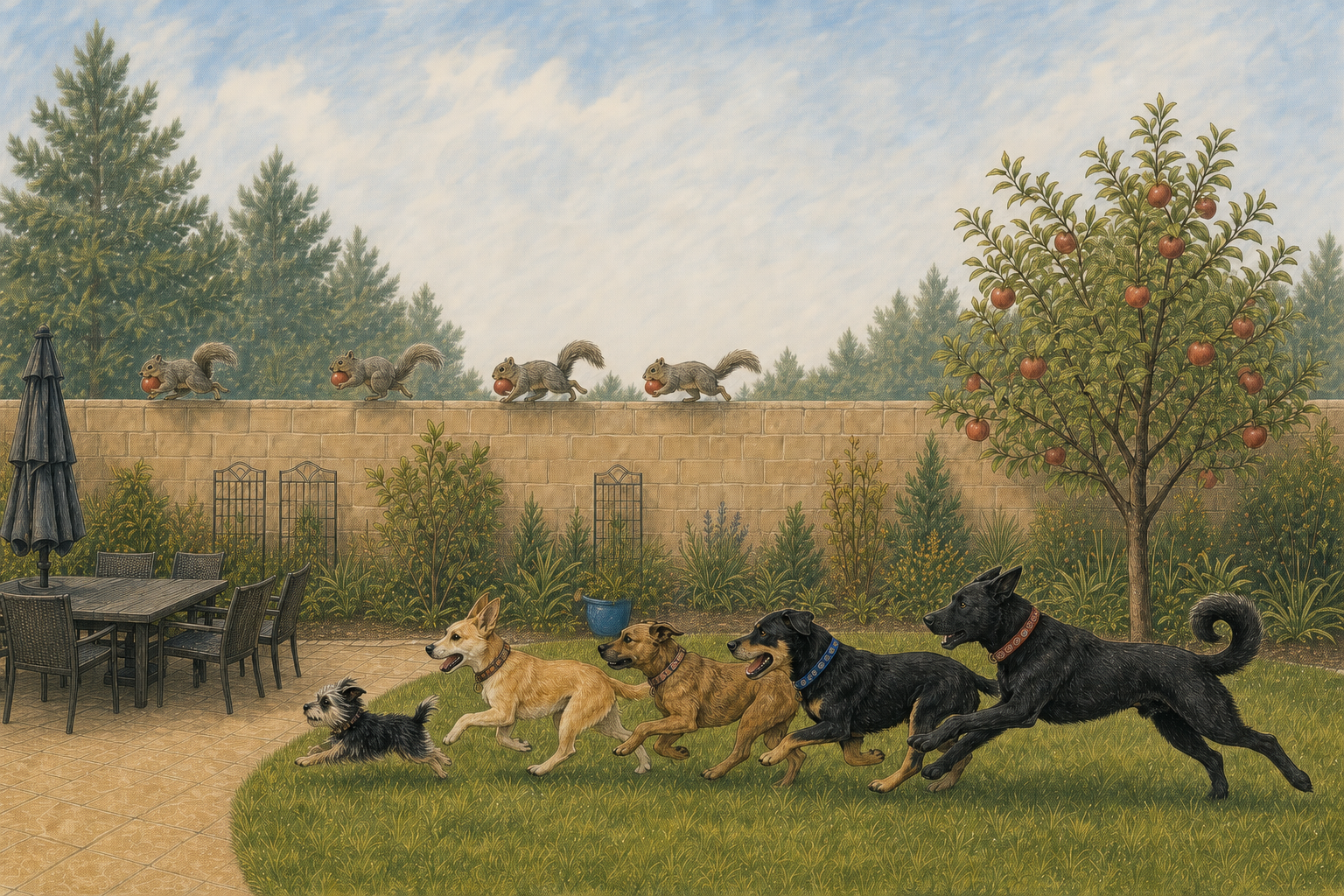
Event streaming is a way to represent what is happening as a continuous flow of records. Instead of waiting for a finished daily report, systems can observe, process, and act while events are still unfolding.
Meet the pack
1. Something happens: the event
A squirrel takes an apple. That is an event—something meaningful that happened at a particular time. Businesses and machines generate events constantly: a customer places an order, a package changes location, a payment fails, or a device reports a temperature.
The event exists whether or not anyone records it. But if the squirrel vanishes, the observation may vanish too.
2. The event becomes a record
Eve watches the yard and produces a compact description: APPLE TAKEN · MOVEMENT LEFT. Now the pack has a durable piece of information that can travel, be stored, and be processed.
A useful event record often includes a type, timestamp, identifiers, and details about what changed. The record is not the real squirrel; it is a structured representation of the squirrel’s activity.
3. Records enter the Bark Line
Individual barks would be easy to miss, so the dogs create a Bark Line along the wall. Records enter in sequence. The pack can follow new activity immediately or revisit earlier messages later.
This is the story’s Apache Kafka analogy: producers publish records to a durable stream, and consumers read them independently.
4. A stream is more than one message
One record says an apple moved. A stream reveals behavior over time: apples repeatedly move left, empty-pawed squirrels return right, and the activity accelerates near the tree. Continuous records let the pack detect the unfolding pattern.
Event streaming systems preserve this flow so applications can react in real time, build live views, trigger workflows, and reconstruct what happened.
5. Flink adds the missing context
The first records contain direction but not identity. Ollie and Amira chase a beetle and a leaf because raw movement is ambiguous. Carter uses Apache Flink to enrich the stream.
Flink combines movement with information from around the yard. “Movement left” becomes “monarch butterfly flying left.” Another record becomes “squirrel on the wall, moving right, headed to the apple tree.” Processing converts timely data into useful information.
6. The pack acts on enriched events
Carter identifies patterns. Kayla sees the complete Apple Run and plans where the pack should go next. The value is not the stream by itself; the value is making a better decision while the information still matters.
Real organizations use similar patterns for fraud alerts, logistics, recommendations, industrial monitoring, security, financial markets, and customer experiences.
7. WarpStream keeps the Bark Line in the pack’s cloud
The dogs do not want the whole neighborhood hearing their squirrel records. In the story, WarpStream keeps the Kafka-compatible Bark Line running in the pack’s own cloud while their secret key protects stored messages.
WarpStream is a Kafka-compatible data-streaming platform built around cloud object storage. The story uses it to introduce the idea that teams can preserve familiar Kafka interfaces while choosing a different cloud-native architecture for storage and operations.
The architecture behind the adventure
- Backyard activityReal-world events happen continuously.
- Event recordsProducers capture structured descriptions.
- Kafka-compatible streamRecords travel and remain available.
- Flink processingThe stream gains context, state, and meaning.
- Real-time decisionsConsumers act on useful results.
Event-streaming vocabulary
- Event
- Something meaningful that happened.
- Record
- A structured description of an event.
- Stream
- A continuing sequence of records.
- Producer
- A system that publishes records.
- Consumer
- A system that reads and uses records.
- Topic
- A named stream of related records.
- Enrichment
- Adding useful context to an event.
- State
- Information remembered while processing events.
- Real time
- Processing while the information is still timely.
Where the analogy stops
Dogs do not configure brokers, checkpoints, schemas, access policies, or cloud storage. The Great Apple Run is a conceptual bridge, not product documentation. It gives beginners a mental picture they can carry into the technical details.
And yes: even the best information system cannot make the backyard wall any shorter. The squirrels still escape with the apples.