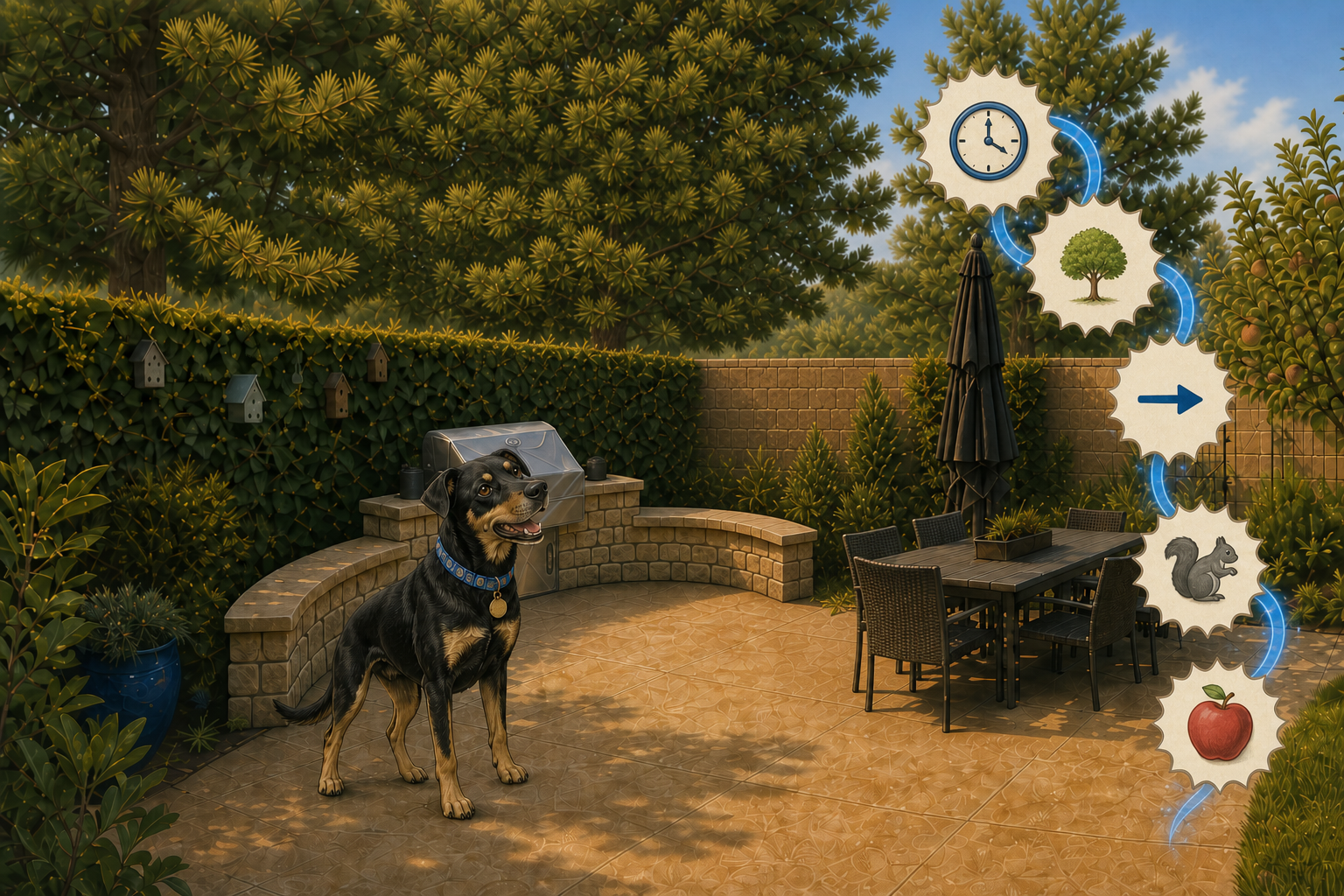
Apache Flink is a stream-processing engine. It reads continuously arriving records, remembers useful state, performs calculations, and emits new results—without waiting for the stream to end.
Why movement alone is not enough
The Bark Line first carries a simple observation:
MOVEMENT: LEFTThat record says something happened, but not what happened. Was it a squirrel, butterfly, leaf, or beetle? Where was it? Did it have an apple? The event is timely but incomplete.
Carter uses Flink to combine the moving record with information from around the yard. The result is much more useful:
ANIMAL: SQUIRREL
LOCATION: WALL
DIRECTION: RIGHT
DESTINATION: APPLE TREE
What does Flink actually do?
Flink runs computations over streams that may continue indefinitely. Instead of collecting a day’s worth of records and processing them tomorrow, a Flink job can respond as the records arrive.
Common Flink work includes filtering events, transforming formats, joining streams, enriching records with reference data, recognizing patterns, calculating running totals, and producing alerts.
Stream enrichment
Enrichment means adding useful context to an event. A raw order record might contain a customer ID; enrichment adds the customer’s region and account tier. A sensor record might contain a device ID; enrichment adds the device type and facility. The story turns anonymous movement into a squirrel’s location and direction.
Flink can combine the incoming record with another stream, a lookup table, or state accumulated from earlier events. The enriched output becomes easier for downstream systems—and dogs—to act on.
State: remembering what matters
Many streaming questions require memory. Has this squirrel appeared before? How many apples moved in the last minute? Is this direction unusual for an empty-pawed squirrel? Flink manages state alongside the computation so each new event can be understood in context.
State is more than a variable sitting on one machine. Flink is designed to preserve consistent processing state across distributed workers and recover it after failures.
Event time and late arrivals
The time an event happened can differ from the time it reaches the processor. A yard sensor might briefly lose its connection, then deliver an older observation. Flink can reason using event time, allowing a computation to reflect when the squirrel actually moved rather than only when the record arrived.
Windows: making an endless stream answerable
A stream has no natural ending, so questions often need boundaries. A window groups events by time or count. The pack could ask, “How many apples moved during the last minute?” or “Which direction appeared most often in the latest ten records?”
Flink supports several windowing strategies. The important beginner idea is simple: windows turn a continuous stream into useful, repeatable slices.
Does Flink replace Kafka?
No. Kafka carries and retains the records; Flink processes them. A Flink job can read from Kafka, transform the records, and write results back to another Kafka topic or an external system.
The technologies overlap around streaming, but their primary responsibilities differ. Kafka is the Bark Line. Flink is the clue finder working over that line.
The analogy in one minute
- Movement record
- A raw event entering the processor
- Carter
- A Flink job applying stream logic
- Yard clues
- Reference data and processing state
- Completed squirrel record
- An enriched output event
- Kayla’s decision
- A downstream action based on the result
Where the analogy stops
Real Flink systems also involve parallel operators, checkpoints, savepoints, watermarks, connectors, deployment modes, backpressure, and careful operational design. The story focuses on the durable mental model: process events continuously, remember the right context, and create results while the information is still valuable.